
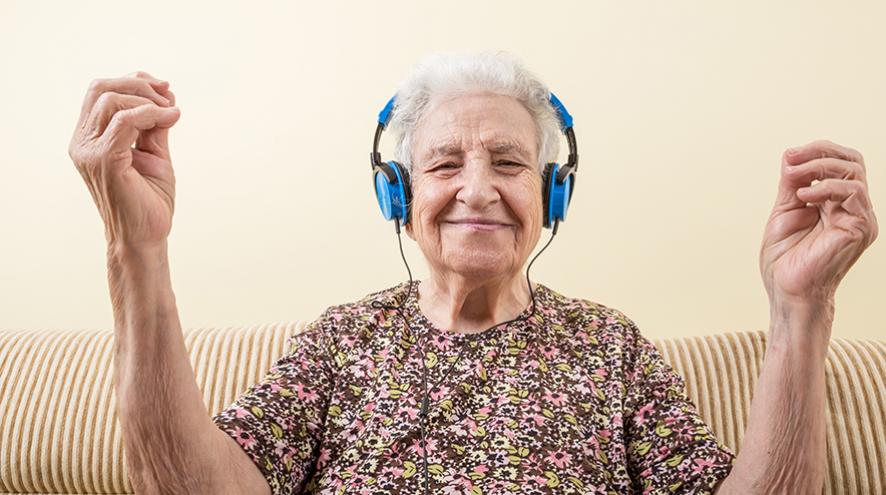
More and more people are looking for ways to keep their later years active, mentally sharp and balanced. Alongside regular exercise, good sleep, social connections and mental activity, many people also try complementary relaxation methods.
One of these is audio-visual stimulation (AVS), which works with a combination of sound and light. But how does this method work, and what does research say about it? In this article, we look for the answer.
How does sound and light impulse stimulation work?
The AVS device delivers rhythmic light impulses through special glasses, together with matching sound impulses through headphones. It has long been known from EEG research that the brain’s electrical activity can follow a rhythmic light stimulus – this is known as photic driving.[1] According to the literature, this requires the stimulation to be even and rhythmic.[1]
The programs are built on this principle: slower-paced programs are designed to support relaxation and calming down, while faster ones accompany a more lively, refreshed state. Meanwhile, the user sits or lies comfortably and rests with closed eyes.
What does the research show?
Relaxation: According to a report by researchers at Semmelweis University, longer sessions of light-sound stimulation have been observed to produce physical relaxation, reduced muscle activity and physiological changes typical of a resting state.[2]
Mental performance and stress relief: According to an independent Hungarian review from the University of Debrecen summarizing 24 peer-reviewed studies, cognitive performance and stress relief are among the most frequently studied areas of AVS application.[3]
Evening wind-down: In an experimental study conducted with older adults, a gradually slowing evening program supported winding down before bedtime.[4]
Older age group: In studies described by the manufacturer, conducted with residents of care homes for the elderly, participants’ performance on memory tasks improved.[6]
Safety: According to an independent systematic review, light-sound stimulation can be applied safely and non-invasively to achieve favorable, calm mental states.[5]
At the same time, researchers consistently point out that further, well-controlled studies are needed in this field.[3][5] That is why we, too, regard AVS for what it is: a pleasant, complementary relaxation option.
How does a session work?
The programs require a DAVID Delight Agytréner device. The user puts on the headphones and light glasses, selects a program, and then rests for 20–30 minutes. The programs can be used at home, either independently or with the help of a family member – so the daily program can even become a shared ritual.
To get started, we recommend a personal assessment: we get to know your goals and daily habits, put together an individual program plan based on these, and later discuss your experiences together. The assessment is not a medical examination and does not replace a medical diagnosis.
Who should not use it?
The device must not be used by anyone with epilepsy or a susceptibility to photosensitive seizures, or by anyone with a pacemaker or other implanted electronic device. The CES function is not recommended during pregnancy. If you have an existing condition or are taking medication, please consult your doctor before use.
Summary
Audio-visual stimulation is not a cure, but a convenient relaxation option that can also be used at home and fits well into a mindful, active lifestyle. If you are curious how it could fit into your day, or that of an older loved one, sign up for a personal assessment and we will help you find the right program and device.
References
- Siever, D. & Collura, T. (2017): Audio–Visual Entrainment: Physiological Mechanisms and Clinical Outcomes. In: Rhythmic Stimulation Procedures in Neuromodulation, Elsevier, 51–95. DOI: 10.1016/B978-0-12-803726-3.00003-1. Co-author is the founder of the manufacturer. Supplemented by: Collura, T. F. & Siever, D.: Auditory-visual entrainment in relation to mental health and EEG. In: Introduction to QEEG and Neurofeedback, Ch. 8 – this describes Adrian and Matthews’ (1934) observation that the brain’s alpha rhythm can be driven by photic stimulation.
- Fábián, T. K., Kovács, K. J., Gótai, L., Beck, A., Krause, W-R. & Fejérdy, P. (2009): Photo-acoustic stimulation: theoretical background and ten years of clinical experience. Contemporary Hypnosis, 26(4): 225–233. DOI: 10.1002/ch.389 – Semmelweis University, HAS Research Centre for Natural Sciences (KOKI); independent of the manufacturer.
- Szabó Gergely – Szabó Csaba (2014): Practical Applications of Audio-Visual Stimulation. University of Debrecen, Faculty of Humanities, Institute of Psychology (TÁMOP 4.2.4.A/2-11-1-2012-0001). A review of 24 peer-reviewed studies; independent of the manufacturer. Due to methodological inconsistencies, the authors recommend better-controlled studies.
- Tang, H-Y., Vitiello, M. V., Perlis, M. & Riegel, B. (2015): Open-Loop Neurofeedback Audiovisual Stimulation: A Pilot Study of Its Potential for Sleep Induction in Older Adults. Applied Psychophysiology and Biofeedback, 40: 183–188. DOI: 10.1007/s10484-015-9285-x – independent of the manufacturer; a small-sample (8 participants) pilot study without a control group.
- Furtado da Silva, V., Ribeiro, A. P., dos Santos, V. A., Nardi, A. E., King, A. L. S. & Calomeni, M. R. (2015): Stimulation by Light and Sound: Therapeutic Effects in Humans. Systematic Review. Clinical Practice & Epidemiology in Mental Health, 11: 150–154. Independent of the manufacturer; the authors note the low number of studies included.
- Mind Alive Inc.: Seniors’ Studies with Mind Alive Devices (summaries of care-home studies by T. Budzynski, C. Palmquist, C. Berg). Manufacturer summary, not a complete, peer-reviewed publication.
Important information. Agytréner devices are intended for relaxation and general well-being purposes and are not medical devices. They are not suitable for preventing, detecting, treating or curing any disease, and do not replace medical examination, diagnosis or treatment. If you have an existing condition or illness, or are taking medication, please consult your doctor before use. The device must not be used by anyone with epilepsy or a susceptibility to photosensitive seizures, or by anyone with a pacemaker or other implanted electronic device; the CES function is not recommended during pregnancy. The experiences described are individual user feedback, not guaranteed results.