

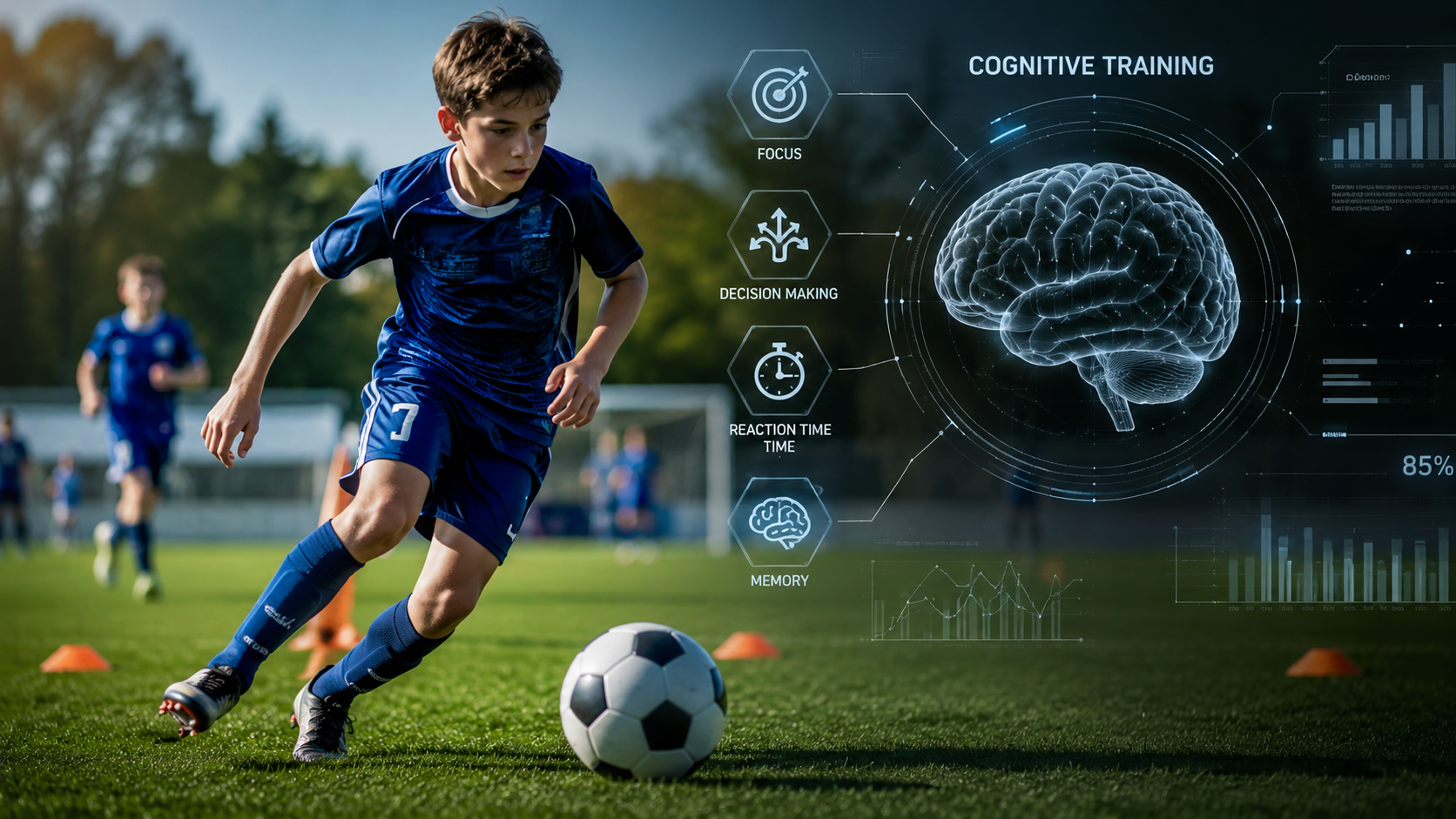
The best decisions on the pitch are made in the brain
A science-based cognitive development system for young football players — qEEG, HRV, and audio-visual stimulation for peak performance
⚽ For young football players | 📄 With scientific background | 🕐 6-minute read
Why train the brain?
During a match, a player’s brain must simultaneously interpret multiple visual, auditory, and motor stimuli — from teammates’ positions through the opponent’s movements to the coach’s instructions. Every decision is made in the brain before the muscles execute it. The faster and more accurate this process is, the better the player’s performance on the pitch.
Neuroscience research now clearly confirms: the brain’s brainwave activity is a measurable biomarker of sports performance. Elite football players differ from average players not only physically and technically — their cognitive advantage is also measurable and trainable.
Brainwaves in football
Scientific research has mapped out exactly what each brainwave frequency does for sports performance. The Agytréning system develops these frequency bands in a targeted, personalized way.
4–8 Hz
Theta
Working memory, passing decisions, processing tactical sequences. Increases before a shot in experts.
8–13 Hz
Alpha
Relaxed focus, the indicator of the „flow” zone. Higher alpha activity is characteristic of successful performance.
14–30 Hz
Beta
Active decision-making. Excessively high beta can cause anxiety and freezing at critical moments.
1–4 Hz
Delta
Deep sleep, regeneration. Higher delta amplitude has been measured in ball-sport athletes at rest.
Source: Cheron et al. (2016) — EEG Biomarkers of Sport Performance; Baumeister et al. (2008); Doppelmayr et al. (2008)
Audio-Visual Stimulation
At the heart of the Agytréning system is Audio-Visual Stimulation (AVS). The retina of the eye and the ear detect rhythmic light and sound pulses, which reach the cerebral cortex via the thalamus. Within six to eight minutes, the brain „tunes in” to the targeted frequency — this is called the frequency-following response.
The MindAlive DAVID brain-trainer device has unique technology: the two brain hemispheres can be stimulated at different frequencies. Other devices are not capable of this. This dual stimulation allows for more precise, more targeted development, tailored to the complex cognitive demands of football.
What exactly does it develop in a football player?
Decision-making and mental speed
In passing situations, the brain’s working memory processes options at theta frequency. Pre-learned tactical patterns become automated and accessible more quickly. Cognitive training enables faster reactions to unexpected situations — without the player consciously „thinking” about the decision.
Peripheral vision and game anticipation
Elite players recognize patterns of play before they fully unfold. This is partly tactical memory acquired through training, and partly advanced visual processing — both of which can be influenced by the qEEG-based training program.
Emotional control and stress management
Anxiety raises beta activity, which slows down decision-making and impairs technical execution. AVS training reduces anxiety levels by strengthening the alpha range, helping the player stay calm and focused even in the critical moments of a match.
Regeneration and sleep quality
Post-training improvement is consolidated during sleep. Strengthening the delta range enables deeper, more effective regeneration. Studies show that the training program improves the speed of falling asleep by 80%, and participants’ morning restfulness score rose above 70%.
49%
increase in brainwave amplitude from AVS light stimulation
+10
IQ point improvement demonstrated in studies (Raven test, 40 sessions)
18 mo
later, the effect of cognitive development remained measurable
The 6-week development program
The Agytréning system creates an individual assessment for every player. Based on the measurement results, a personalized 6-week training plan is created — because the same program produces different results for different brainwave patterns.
Why is it worth starting young?
Ages 10–18 are a critical period for brain development. Neuroplasticity — the brain’s ability to build new neural connections — is at its highest during this age range. Through active use, neurons form axonal and dendritic connections, and new networks are built.
What becomes ingrained as an automated skill at a young age will keep working even in the most critical moments of a match, when tired and under pressure. Physical training and cognitive development amplify each other.
Request an assessment!
The assessment shows where the potential for improvement lies. The 6-week, personalized program helps achieve peak cognitive performance — both on and off the pitch.
or call us: +36 30 996 3185