
Learning & Development
Reading is painful. Math class is a nightmare. What’s going on in that child’s brain?
Agytréner Blog · Reading time: ~8 min
There are children who are normal, even bright children — this is obvious to anyone who gets to know them even a little. Yet they struggle in school. Reading is slow and inaccurate, they lose the meaning of the text by the time they reach the end of the line. In math, neither explanation nor repetition helps. When taking dictation, they make the same mistakes over and over, as if the previous day had never happened.
Parents, in such cases, usually make the rounds of institutions. Special education teacher, speech therapist, neuropsychologist. The child gets a diagnosis — dyslexia, dyscalculia, ADHD, or some combination of these — and starts development sessions. Often something improves, but school performance largely stays the same.
This article is about why this happens, and about what development sessions cannot change, but brain training can.
What happens in the brain during reading?
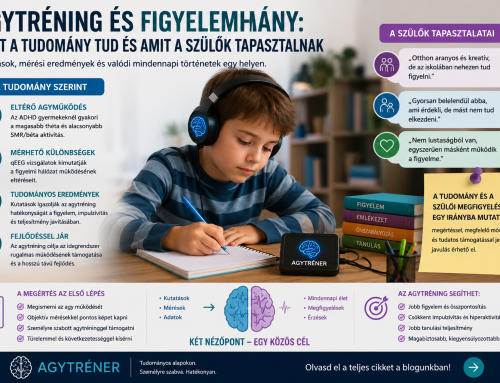
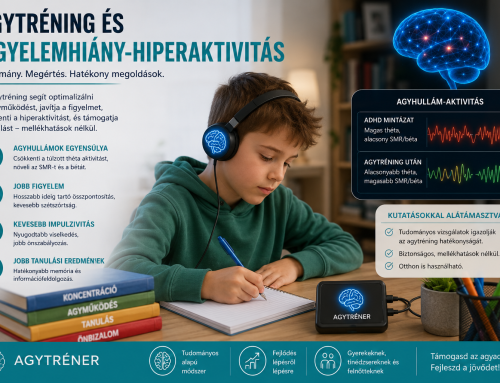
Behind school learning difficulties there is almost always a specific, measurable neurological pattern. The qEEG (quantitative EEG, computerized analysis of brain waves) shows a very characteristic picture in children with ADD/ADHD and reading difficulties: slow, so-called theta waves dominate in the frontal lobe area, and this pattern becomes even stronger during reading.
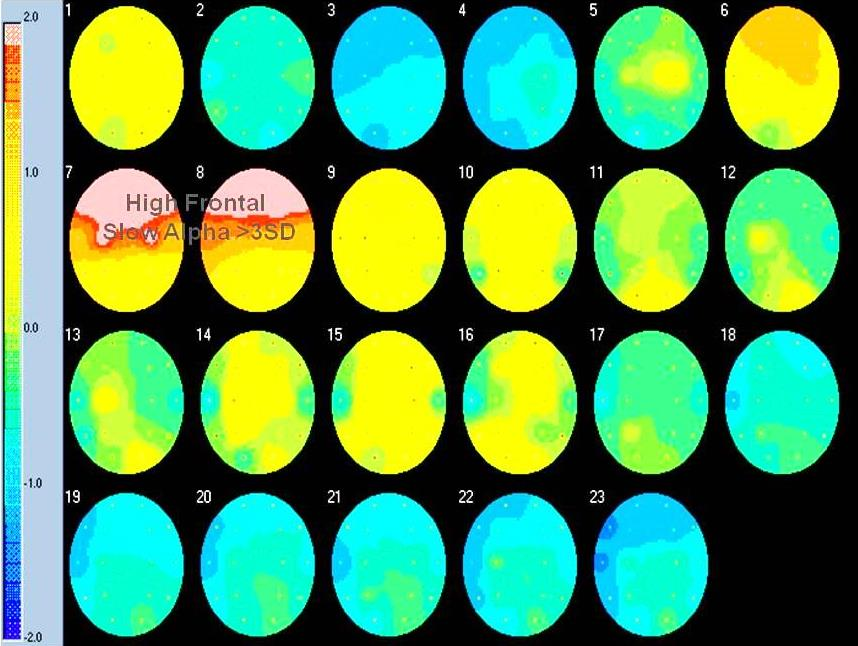
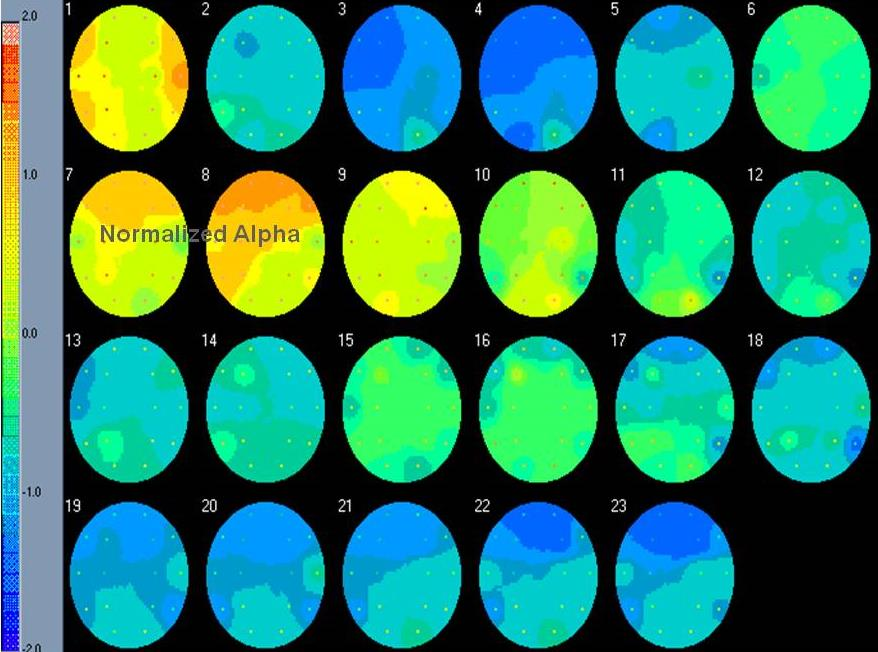
Fig. 8.15–8.16 — QEEG brain map, before and after. Top: “High Frontal Slow Alpha >3SD” — a typical ADD profile. Bottom: the same person 20 minutes after an AVE session, the frontal activity has visibly normalized. (Source: Collura & Siever, in Evans: Neurofeedback, 2008)
8–10%The proportion of school-age children in Hungary affected by some form of ADHD and attention disorder
~20%Nearly one-fifth of children with learning difficulties are dyslexic — in many cases undiagnosed
Why isn’t development therapy enough?
Special education pedagogy and speech therapy are very useful. They teach strategies, reinforce conscious techniques, and in many cases produce measurable improvement. However, these methods try to influence the brain from the top down: they teach a rule and hope that it stays there.
The fundamental question is whether the brain is even ready to receive it. If the nervous system operates persistently in a slow mode, if the frontal lobe does not activate properly during task performance, the learned rules do not become permanently established. The brain operates on a 72-hour cycle — whatever is not reinforced repeatedly gets pushed out by the system.
Brain training comes in at a different point. It directly modifies the brainwave pattern, increases blood flow to the frontal areas, and creates a neurological state in which learning becomes easier and more effective.
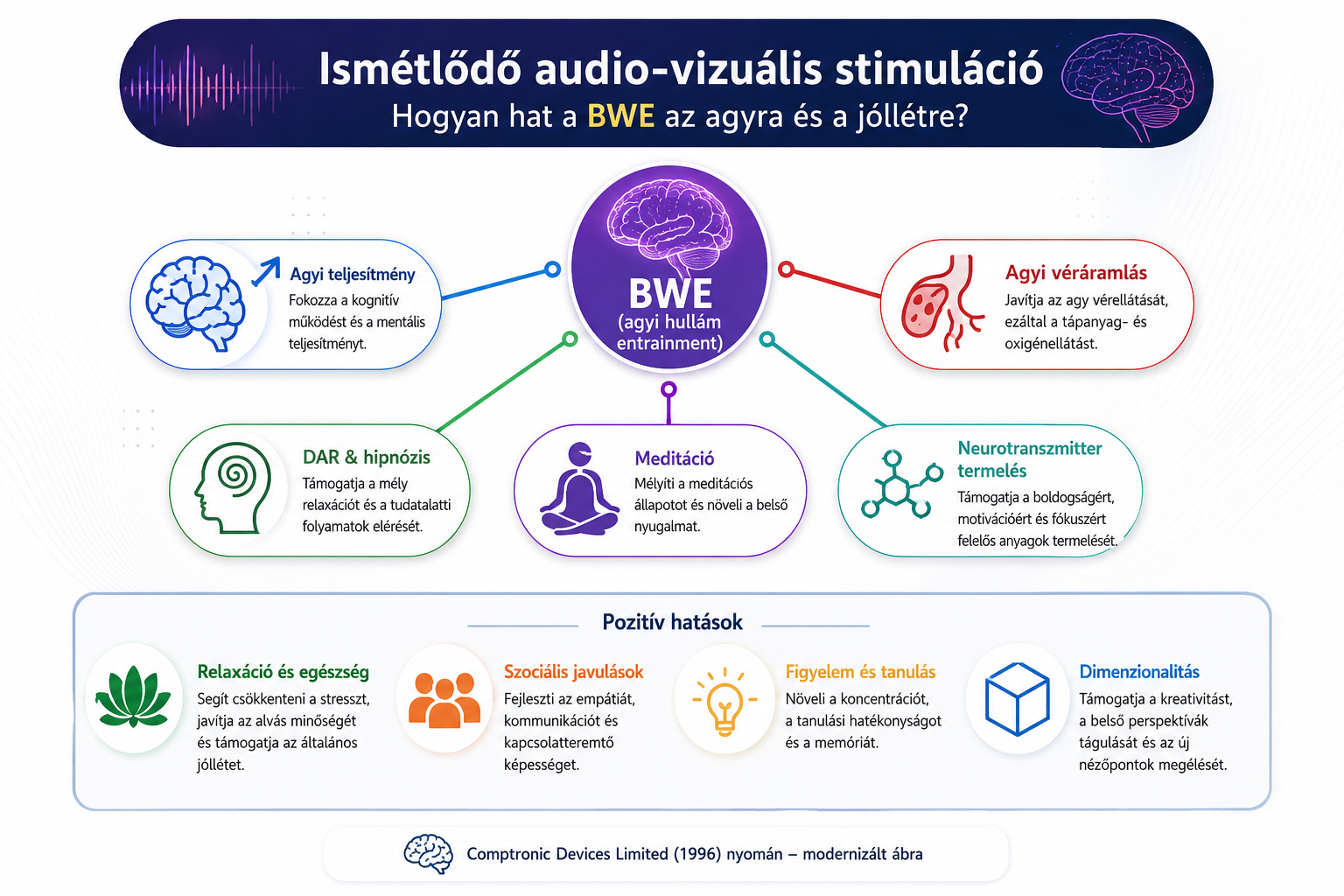
The complex neurological effects of AVE (audiovisual entrainment). Brainwave synchronization simultaneously influences cerebral blood flow, neurotransmitter production, the deep relaxation state, and attentional and learning functions. (Source: Comptronic Devices Ltd, 1996)
The assessment: what do we measure and why?
How does audiovisual stimulation work?
The Agytréner device sends pulsing light and sound impulses through special LED glasses and headphones. The brain senses these stimulation frequencies and, after 6–8 minutes, begins to tune in to them — this is called the frequency following response.
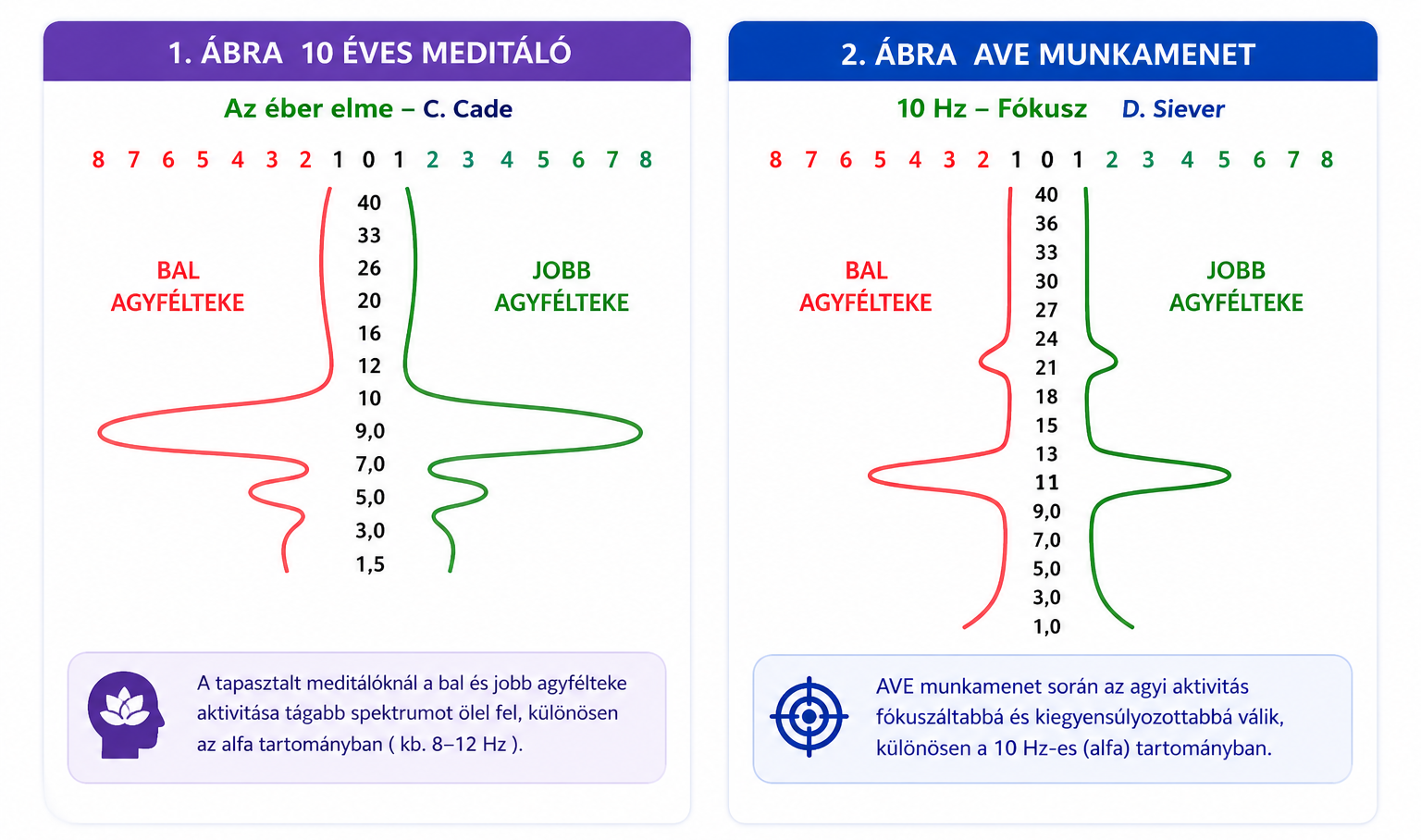
Brainwave pattern of a 10-year-old meditator (left) and the result of a 10 Hz AVE session (right). The two samples are strikingly similar — the training brings the brainwaves into a more orderly, more focused state, without requiring years of meditation practice. (Source: Siever, 1997)
The process works through the thalamus: every sensory stimulus is filtered there, and from there it is relayed onward to the cortex. The device can also stimulate the two brain hemispheres with independent frequencies — beta on the left side, SMR+alpha range on the right — which also improves the hemisphere coordination needed for reading. This dual stimulation technique is made possible by patented glasses.
What does the research say?
Audiovisual brain stimulation has been used in organized form since the 1980s, and over the past decades numerous clinical studies have been conducted with training performed on children.
Clinical study — 1993
Carter & Russell — boys with learning difficulties, ages 8–12
A double-blind study was conducted with 26 boys aged 8–12 with learning difficulties. The children took part in 40 AVE sessions, at 10 Hz and 18 Hz.
An average of +8 IQ points on the Raven test · Significant improvement in memory, reading and spelling (p<0.01)
“ADD and Learning Session” — the Joyce protocol. The sheet describes the study (30 elementary school children with ADD and reading difficulties, from two Minnesota schools) and shows the dual-frequency program. Published in: Journal of Neurotherapy, Vol 4, No 2. (Source: Siever: AVE Session & Protocol Guide for Professionals, 2022)
School program — 1998
Michael Joyce — 30 elementary school children with ADD and 8 with reading difficulties, Minnesota
A 10-week program in two schools. Ten children were treated at a time. Attention measures, reaction time and impulse control all showed measurable improvement. A second study was then conducted with 204 children from seven schools, with similar results.
18 months of progress in reading level · Half a year of advancement relative to grade level
How is the training structured?
📊
Assessment
qEEG, HRV, cognitive test, visual response — individual brain profile
🧠
6-week training
3–5 sessions per week, individually tailored frequency protocol
📈
Re-assessment
Documented change, planning of the next cycle
The Agytréner system operates in 6-week cycles. This time span is enough for the brain not just to temporarily but permanently adopt the new operating pattern. For specific learning disorders — dyslexia, dyscalculia, dysgraphia — we start from the so-called mid-alpha range and gradually progress toward the individual target frequency. No more than 72 hours may pass between sessions, so that the brain does not “forget” the direction.
Hungarian clinical experience shows that children begin to show visible changes, noticeable to others as well, around the 6th session — usually first in sleep and mood, and only afterward in school performance. The training does not replace school remedial sessions. It increases their effectiveness, because with a more orderly brainwave pattern, the strategies learned become embedded much faster and more deeply.
Would you like to know what’s going on in your child’s brain?
The assessment is non-invasive and requires no special preparation. During a free 15-minute phone call, we will review what might be behind it and explain how an individually tailored training plan would be structured.
No obligation. A simple, informal phone call.
REFERENCES USED
- Siever, D. (1997). The Rediscovery of Audio-Visual Entrainment. Comptronic Devices Limited.
- Siever, D. (2003). Audio-Visual Entrainment: Applying AVE Technology for Attention and Learning. Biofeedback, 31(4).
- Siever, D. (2022). AVE Session & Protocol Guide for Professionals. Mind Alive Inc.
- Carter, J. L. & Russell, H. L. (1993). A pilot investigation of auditory and visual entrainment of brain wave activity in learning disabled boys. Texas Researcher, 4, 65–73.
- Joyce, M. & Siever, D. (2000). Audio-Visual Entrainment program as a treatment for behavior disorders in a school setting. Journal of Neurotherapy, 4(2), 9–25.
- Collura, T. F. & Siever, D. (2008). Audio-visual entrainment in relation to mental health and EEG. In Evans, J. R. (Ed.), Handbook of Neurofeedback. Haworth Press.
- National Public Health and Pharmaceutical Center — Information on learning difficulties and ADHD. egeszsegvonal.gov.hu
- Shaywitz, S. (2003). Overcoming Dyslexia. Alfred A. Knopf.