
ADD • ADHD • Cognitive Development
Brain Training and Attention Deficit: What Science Knows, and What Parents Experience
ADHD is not a child’s laziness, and it is not a parenting mistake. It is a brainwave pattern that can be measured – and that can be changed.
László Szalóki • Cognitive researcher, neurotrainer • Bioptima Agytréner Center
If your child is constantly “scattered,” unable to sit through a task, keeps running headfirst into walls, and the school is sending more and more messages – then you probably know the feeling of not knowing who to turn to, what the real problem is, and whether there is any solution at all.
This post is about how it’s worth approaching this question from the perspective of measurement data, what research shows about audiovisual stimulation brain training, and how the 6-week development process that can achieve concrete changes is structured.
The ADHD Brain “Operates” Differently
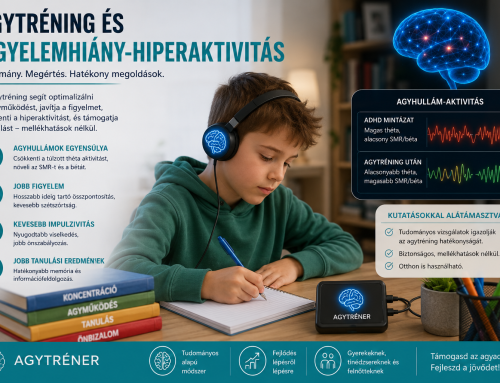
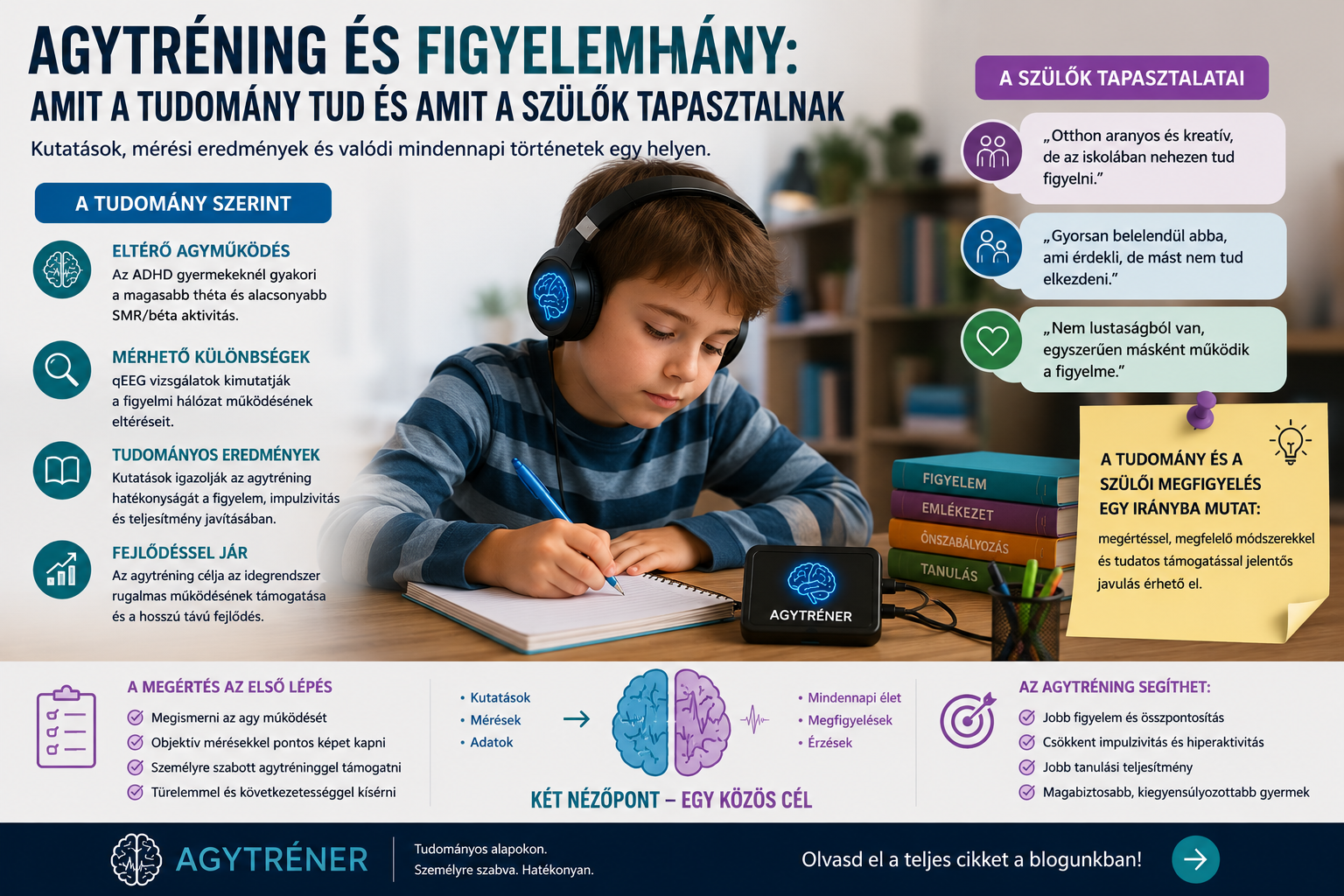
ADHD is not a matter of discipline, and it is not a character flaw. It is a neurological-level difference: in the frontal areas of the brains of affected children, theta waves (4-8 Hz) are dominant compared to beta waves (14-20 Hz). This can be precisely measured with brainwave recordings (qEEG).
This means that the child does not want to be inattentive. Their brain is operating in exactly the state a sleepy person enters. It’s no use telling them to pay better attention – in response to the request, theta activity actually increases. This cannot be rewritten through external pressure.
300 000+
Estimated number of people affected in Hungary
99
children took part in the AVS vs. Ritalin comparative study (Micheletti, 1998)
204
students from 7 Minnesota schools in the Joyce follow-up study
What Does the Research Show?
In the field of audiovisual stimulation (AVS) and audiovisual entrainment (AVE), clinical studies have been conducted since the 1990s. The most important results:
Joyce and Siever’s Study (2000, 2001)
Michael Joyce treated 30 elementary school students with attention disorders with daily AVS, over 31 sessions, each lasting 20 minutes. The measuring instrument was the TOVA test (Test of Variables of Attention). The results showed significant improvement in attention, impulsivity, and reaction time. In the follow-up, 204 children from 7 schools were included; after the training, an average reading improvement equivalent to one school year’s progress was measured.
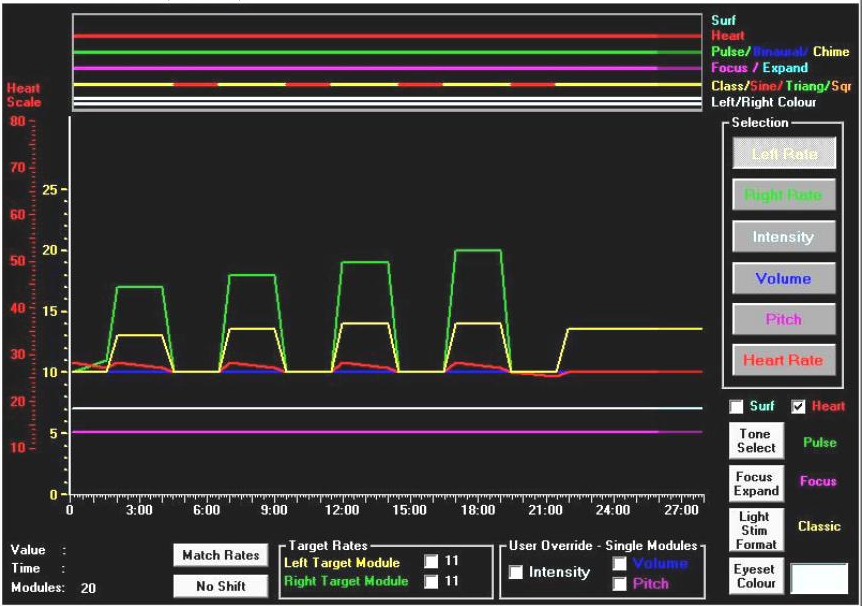
Source: Collura & Siever (2008) – Background of the development of ADD/ADHD protocols: Carter and Russell (1993) used sequences combining 10 Hz and 18 Hz stimulation; Joyce and Siever (2000) worked with a left hemisphere beta / right hemisphere SMR combination.
Micheletti’s (1998) Comparative Study
In a study encompassing 99 children, AVS, Ritalin/Adderall treatment, and combined therapy were compared. The end result: AVS reduced inattention more effectively than medication treatment used alone.
Theta Reduction and Lasting Effect
Collura and Siever (2008) presented a case in which a single 5-minute contingent light stimulation succeeded in permanently reducing excessive theta activity. The graph below shows that even after the stimulation ended, the previously high theta level did not return.
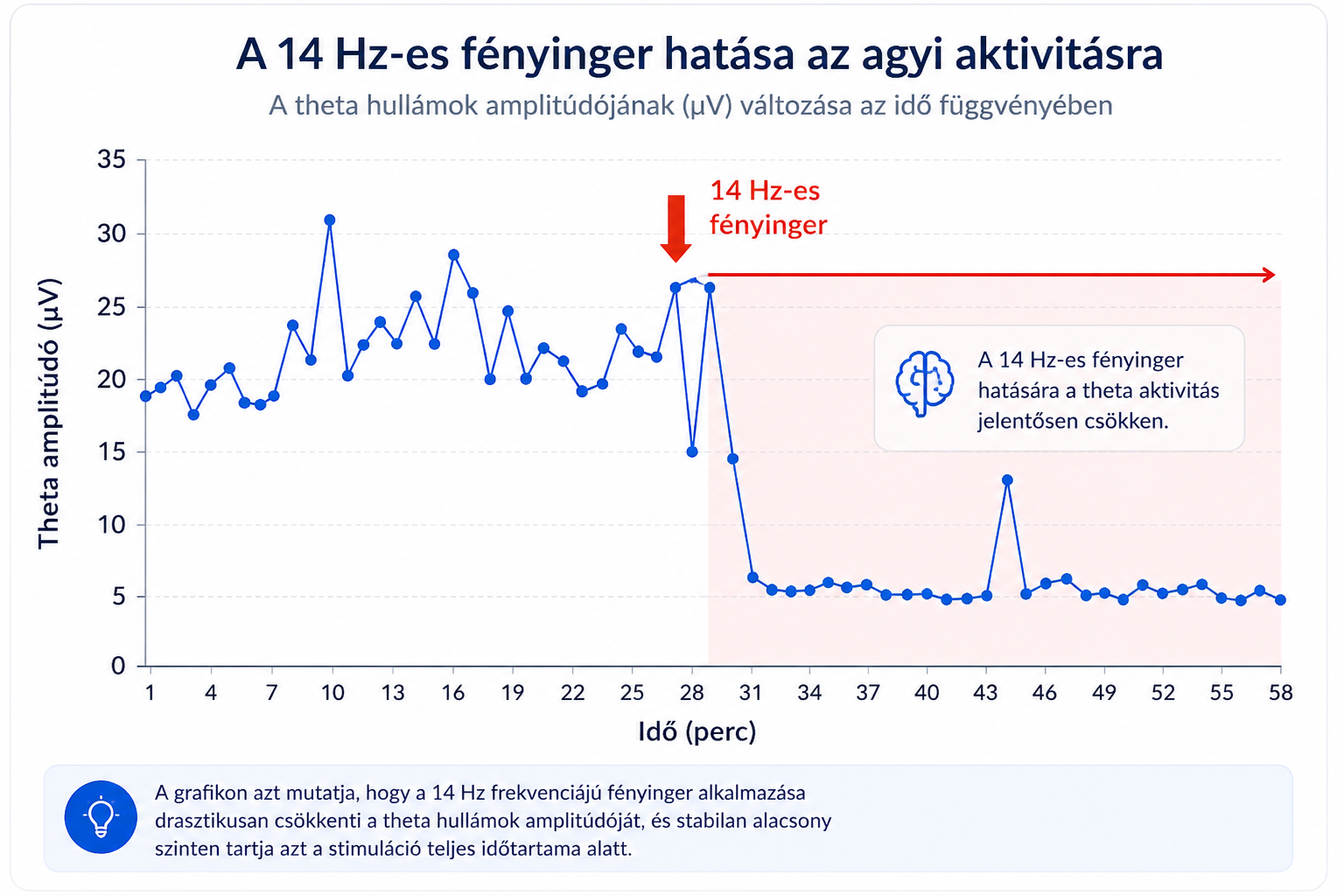
Source: Collura & Siever (2008), Figure 8 – Theta amplitude (4-7 Hz) as a function of time. Conventional neurofeedback in the first 30 minutes. From minute 30 to minute 35, contingent light stimulation (14 Hz). From minute 35 onward the stimulation ceased – the theta level remained persistently low.
QEEG Recording: Before and After
Brain mapping (quantitative EEG) makes the different brainwave patterns visible. The image pair below shows the QEEG recording of a 22-year-old ADD-fibromyalgia patient: on the left, the state before training (frontally prominent, slowed alpha), on the right, the normalized activity after training.
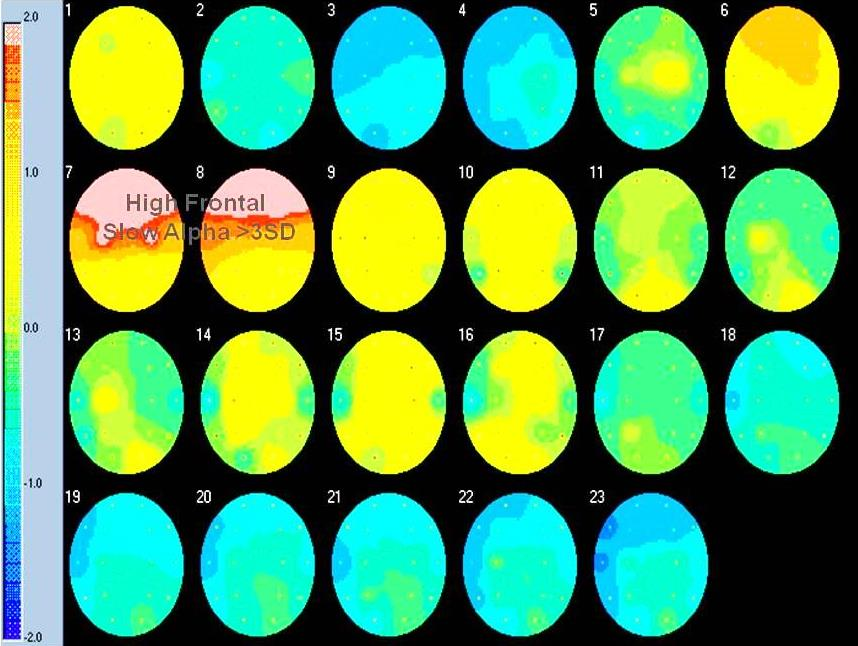
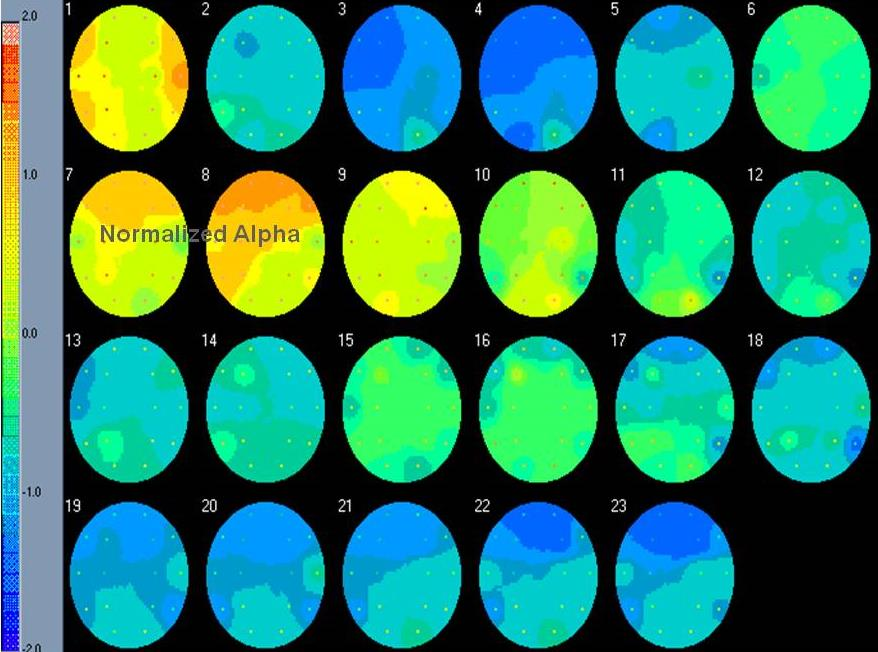
Source: Collura & Siever (2008), Figures 15-16 – Left image: high frontal slowed alpha (>3 SD deviation from the normative database). Right image: normalized alpha activity after 7.8 Hz AVE. Based on the SKIL database.
Why do exactly these variables show improvement?
Collura and Siever (2008) describe the mechanism behind the changes on several levels. Beyond the direct effect of brainwave modulation, at least four other pathways are involved.
AVS increases cerebral blood flow (cerebral perfusion), thereby increasing the oxygen and glucose supply in the prefrontal cortex – exactly where hypoperfusion is most characteristic in ADHD. Functional MRI and SPECT studies also point to this connection: the brain image of attention disorders is typically associated with hypoperfusion (Teicher et al., 2000).
The stimulation also acts at the neurotransmitter level. Shealy and colleagues (1989) measured significant increases in serotonin, endorphin, and norepinephrine following 10 Hz light stimulation. This directly affects mood, impulsivity, and attention regulation.
The third mechanism is the calming of the autonomic nervous system. Muscle relaxation, decreased skin resistance, and normalizing heart rhythm measured within 6–10 minutes during AVS alpha sections indicate that a calming process also begins at the level of the amygdala and the hypothalamus. In most children with ADHD, this self-regulating ability is weaker – and the training strengthens exactly this.
The cycle of attention deficit disorder in a child’s life
It’s worth understanding this process from the parents’ point of view as well. ADHD doesn’t only affect learning. Because of inattention and impulsivity, the child ends up in a socially more difficult position too: teacher-student conflicts, exclusion by peers, loss of self-confidence. Failures accumulate. At home, the tension shows up in the morning routine, at homework time, and in the battles around bedtime.
The connection with sleep is also not negligible. Disturbed melatonin production is a documented phenomenon in ADHD – and deteriorating sleep quality feeds back into daytime attention. After a bad night, concentration becomes even harder, which leads to further failures.
The brain training protocol addresses this cycle at several points at once: a morning beta/SMR session targets daytime alertness, an evening alpha program eases falling asleep, and both directions contribute to strengthening the regulatory system.
How is the development process built up?
At the Bioptima Agytréner Center, every development program starts with an assessment phase. The reason is simple: when ADHD is suspected, several different conditions can produce similar symptoms (anxiety, sleep disorder, trauma), and the direction of treatment differs in these cases. Based on the data from the combined assessment, a personalized program is created.
1
Integrated assessment (qEEG, HRV, cognitive test, visual response)
The brainwave map shows where and in what direction the pattern deviates. HRV records the state of the autonomic nervous system. The cognitive tests measure the current level of attention, processing speed, and working memory. The visual response analysis examines how the brain reacts to audiovisual stimulation.
2
Individual training plan – 6-week cycle
The protocol is assembled based on the assessment results: which frequency range, at which time of day, with which color and sound combination. The ADHD protocol typically combines morning beta/SMR sessions with an evening alpha program. HRV breathing technique is included in both phases.
3
Tracking changes, adjusting if needed
After six weeks, the condition is reassessed and compared to the baseline. The tools for measuring improvement: TOVA-type attention test, parental rating scales (e.g. Conners scale), HRV change, and a repeated qEEG recording.
What parents describe during the process
Changes generally don’t happen all at once. In the first few sessions, the child usually reacts with surprise: the device is eye-catching, unusual, and most children like it. Improved sleep tends to appear first, followed by the stabilization of daytime focus, and then the behavioral changes.
It’s important to keep in mind that the training does not replace medical examination, psychological support, or pedagogical accommodation. It complements these – and according to research, it also produces meaningful, measurable changes.
Why is it worth starting from data?
For many parents, an ADHD diagnosis comes with years of uncertainty. Waiting lists, conflicting opinions, conflicts at school, financial burden. Meanwhile, everyday life at home is difficult.
The measurement-based approach isn’t better because it “sounds more scientific.” It’s practical because, from the very starting point, you can work with concrete data. You can see what improves and what doesn’t – and adjust the program accordingly, instead of waiting months for the first feedback.
Brainwaves can be tracked. Attention performance can be measured. Parental and teacher assessments can be compared. This is no guarantee that the same change will occur in every case – but the process starts by knowing where we’re starting from, and in which direction we should be heading.
Free 15-minute consultation
If you would like to understand what the assessment would show for your child, and how the training would fit the current situation, book a free phone consultation. No prior diagnosis is necessary – the assessment itself can provide an answer as to what lies behind it.
Scientific references:
Collura, T. F. & Siever, D. (2008). Auditory-visual entrainment in relation to mental health and EEG. In Evans, J. R. (Ed.), Introduction to QEEG and Neurofeedback (2nd ed., pp. 195–223). Elsevier. •
Joyce, M. & Siever, D. (2000). Audio-visual entrainment program as a treatment for behavior disorders in a school setting. Journal of Neurotherapy, 4(2), 9–15. •
Micheletti, L. (1998). PhD dissertation, University of Houston. •
Shealy, N. et al. (1989). A comparison of depths of relaxation produced by various techniques and neurotransmitters produced by brainwave entrainment. Shealy & Forest Institute. •
Teicher, M. et al. (2000). Functional deficits in basal ganglia of children with attention-deficit/hyperactivity disorder. Nature Medicine, 6(4), 470–473. •
Siever, D. (2003). Applying audio-visual entrainment technology for attention and learning. Biofeedback, 31(4), 24–29.