
Author: László Szalóki · Bioptima Agytréner Center · June 2026
Attention deficit, ADHD and learning difficulty: when the child is not lazy, the brain just works differently
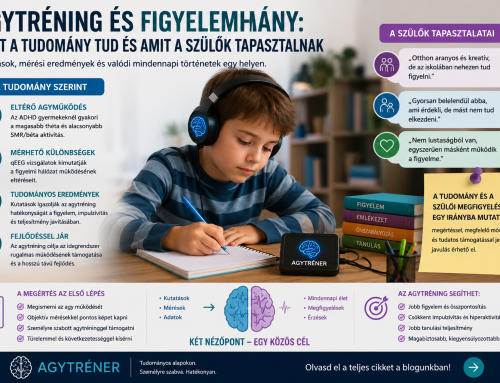
More and more parents see the same picture at home. The child sits down to study, and within five minutes their mind is already elsewhere. The notebook is open, their gaze is on the lines, yet nothing sticks. Homework drags on until evening. Meanwhile tension builds, arguments start, the sentence “pay attention already” comes out – and in the end nothing gets easier for anyone.
In the case of attention deficit, the learning problem is rarely just a matter of willpower. The child often really does want to perform better. It’s just that their brain cannot always maintain that alert yet calm state in which reading, calculating, remembering and working consistently are possible.
This article is for parents who want to understand what is going on in the background, and who are curious how the Agytréner assessment and audio-visual stimulation training can fit into managing learning difficulties caused by ADHD/ADD.
Why is it so hard to learn with attention deficit?
Attention is not a single ability. It is rather a control system that manages several things at once: it selects what the child should focus on, filters out distracting stimuli, maintains alertness, helps switch between tasks, and inhibits impulses. In a school setting, all of this is needed at the same time.
When reading, it’s not enough to recognize the letters. The eyes must track the line, the brain must connect sounds and meaning, working memory must retain the previous sentence while the next one is already arriving. If this system tires quickly, the child appears to be reading – but internally has long since lost the thread.
In the brains of children with attention deficit – especially the ADD type – slow theta waves dominate in the frontal areas. This is not a metaphor: it is a measurable physiological difference. Internally the brain operates in a continuous “movie” mode, and no matter how much the child is told to pay closer attention – the theta level only strengthens in such moments, and the instruction coming from outside does not reach what should actually settle in.
The same child can perform much better in a video game, in sports, or in an exciting situation, because there the stimulus is stronger, the feedback is fast, and the task gives an immediate reward. A math problem, reading comprehension and grammar require an entirely different nervous system state.
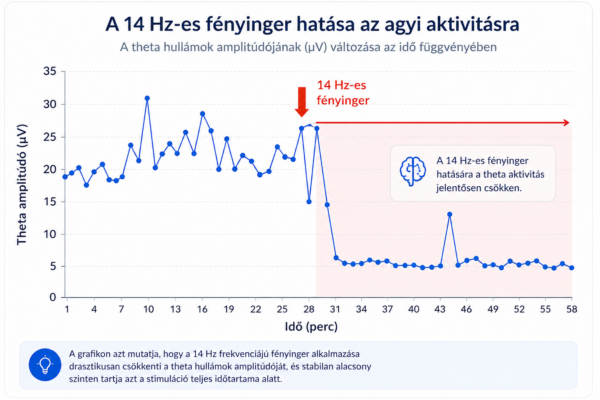
In children with ADHD, the measured reduction of frontal theta activity under the effect of 14 Hz AVS occurs within minutes. Source: Collura & Siever (2009), Siever (2016).
ADD or ADHD: what is worth clarifying as a parent?
In everyday usage, many people treat ADD and ADHD separately. The term ADD is generally used for children with attention deficit who are less hyperactive. They are often daydreamers, slow, scattered – and often stay quiet, which makes it easier to underestimate them. The hyperactive-impulsive type is more visible: they move, talk, interrupt, stand up, act hastily.
The three core symptoms of ADHD are attention deficit, impulsivity and hyperactivity. It has a genetic background, begins in childhood, and persists over the long term. It is less well known that there is also an “overfocused” type, characterized by anxiety, in which activating treatments – including stimulant medications – can sometimes worsen the condition. qEEG-based diagnostics has become more widespread over the past ten years precisely because it can distinguish between these subtypes.
From the parent’s point of view, functioning matters more than diagnosis. In many children, anxiety, sleep problems or a specific learning disability also accompany the attention symptoms – these reinforce one another and need to be treated together.
What do we assess at the Agytréner Center?
The integrated mental state assessment consists of four parts, which together provide a usable picture.
1qEEG brain wave measurement
2HRV stress load test
3Cognitive tests
4Visual response test
qEEG (quantitative EEG) records brain wave activity using 19 electrodes and compares it to a database of healthy individuals. The result is a brain map that shows where and at what frequency there is a deviation. Warmer colors (red, orange) indicate excessive activity, cooler ones (blue) indicate lower activity. In ADHD, there is typically a theta excess in the frontal areas. In identifying ADHD, the method shows sensitivity and specificity above 88% in large-sample studies (Neuropsychology, 1999, 2001).
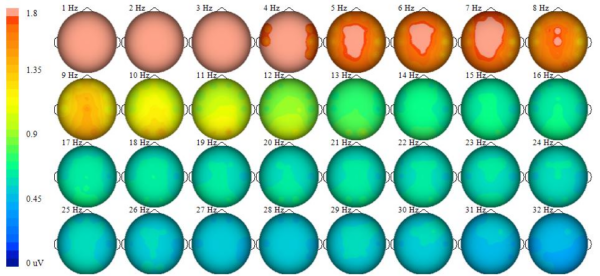
qEEG brain map in ADHD: typical theta dominance in the frontal areas (warm color), posterior regions within the normal range. Source: Siever (2016).
The HRV (heart rate variability) measurement gives a picture of the nervous system’s stress tolerance. In tense, anxious children this value is usually low, which means the nervous system responds less flexibly to changing situations – this makes its effect felt in both attention switching and emotional regulation.
How does audio-visual stimulation work for attention deficit?
Audio-visual stimulation (AVS) uses rhythmic light and sound pulses. The light rhythm arriving through the glasses and the sound frequency heard through the headphones make use of the brain’s tendency to follow frequency – the so-called frequency following response. The brain can give a rhythmic response to a rhythmic stimulus: brain waves are able to entrain to the external impulse. This mechanism acts through the sound and light information running into the thalamus, where all incoming sensory stimuli cross, and from there radiate onward into the cortex – so the entire cerebral cortex becomes reachable.
During the training, the child does not need to “concentrate harder.” Instead, they enter a guided state in which the nervous system can experience more orderly functioning. This is what makes the method especially useful in ADHD: the effect does not come about through willpower.
In ADHD, protocols typically direct the brain toward SMR (sensorimotor rhythm, 12–15 Hz) and the beta range (15–20 Hz). SMR is linked to a calm, orderly bodily state and relaxed attention. The Joyce protocol intended for ADD applies beta (19–21 Hz) to the left hemisphere and an SMR/alpha combination to the right hemisphere – this dual stimulation cannot be carried out with any other device.
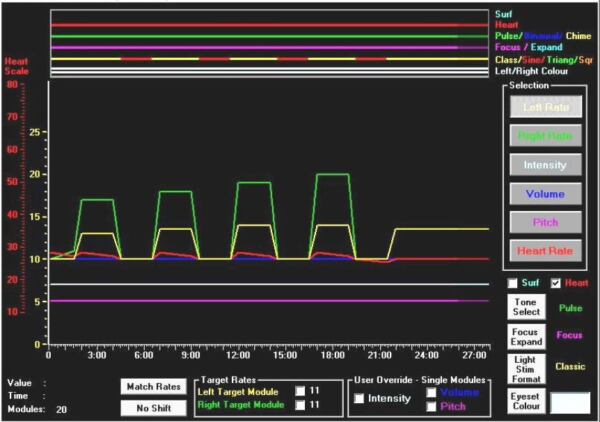
Frequency profile of the Joyce ADD protocol: beta activation in the left hemisphere, SMR/alpha relaxed attention in the right hemisphere. Clinical study: 30 children from Minnesota (Journal of Neurotherapy, 2000). Source: AVE Session & Protocol Book, MindAlive, 2022.
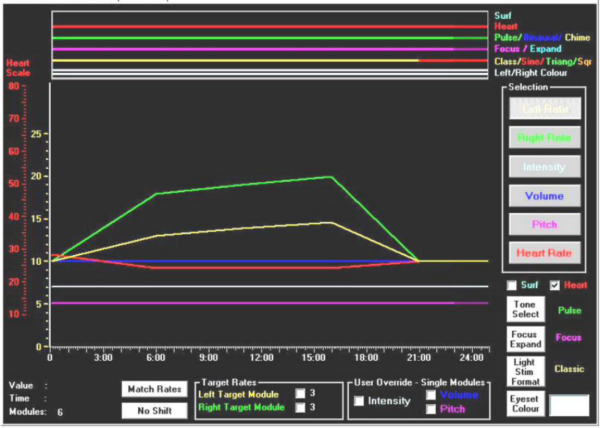
SMR/Beta protocol for ADD treatment: the right hemisphere SMR calms hyperactivity, the left hemisphere beta improves attentional focus. Source: AVE Session & Protocol Book, MindAlive, 2022.
What do the studies show?
Studies of AVS related to attention deficit started with smaller samples – so it’s worth phrasing things with restraint. Still, there are several mutually reinforcing results.
Joyce & Siever (2000) – 30 elementary school children, Minnesota, average age 9.3 years
Children struggling with ADD and reading difficulty took part in an average of 33 sessions (over ten weeks). Attention was measured with the TOVA computerized test – a result considered normal is 100 points, and below 85 represents a one-standard-deviation departure from the norm. The training group improved on every TOVA measure: inattention, impulsivity, reaction time and variability alike. In a larger follow-up study (n=204, seven schools), after 30 sessions anxiety, depression and inattention decreased, and children in grades 1–11 showed on average one grade level of improvement in oral reading level.
Joyce, M. & Siever, D. (2000). Journal of Neurotherapy, 4(2), 9–15.
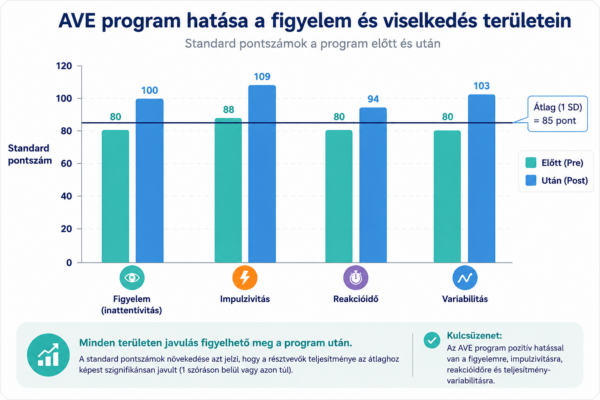
TOVA attention test – change before and after training. Source: Joyce & Siever, 2000.
Micheletti (1999) – 99 ADHD children, Houston – AVE vs. Ritalin
Four groups: control (n=31), Ritalin/Adderall (n=20), AVE (n=21), AVE+medication combined (n=27). Daily 20-minute sessions, 5 days a week, 40 sessions total – at home, under parental supervision. IQ was measured with three tests (WRAT, PPVT, Raven). Both the AVE group and the combined group performed significantly better on inattention measures than the medication-only group.
Micheletti, L. (1999). Doctoral dissertation, University of Houston.
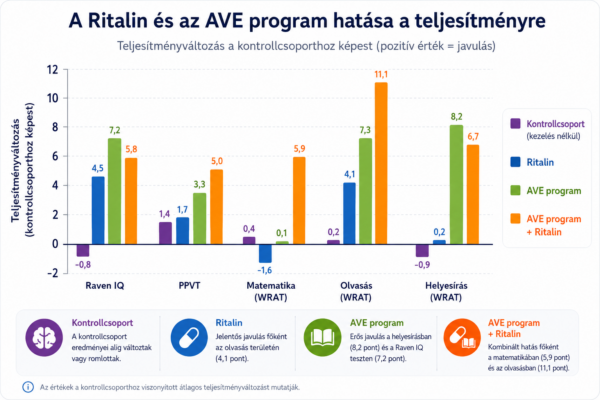
IQ and performance improvement across the comparison of the four groups. The AVE group and the combined group outperformed the medication-only group. Source: Micheletti, 1999.
Carter & Russell (1993) – IQ and behavior, school environment
14 boys struggling with learning or attention difficulties, daily AVS sessions over eight weeks (40 sessions total). The Raven IQ test showed an average improvement of 10 points. Teachers rated a significant positive change on the behavior scale (Burks). Anger control, academic performance, coordination, and tolerance all improved.
Carter, J. & Russell, H. (1993). Texas Researcher, 4, 65–72.
Why isn’t a generic “ADHD program” enough?
The brainwave profile of two children with attention deficit can differ radically from each other. One child struggles with frontal theta dominance, while in the other, high beta signals anxiety or overfocusing. Treating them the same way is like giving the same glasses to every child who has a problem with their eyesight.
Brain training works like exercise: through repetitions, cycles, gradual development. After the third or fourth session, the brain already “knows” that training is underway, and it settles into the expected state more and more easily. This is why we work in 6-week cycles, with follow-up measurement and fine-tuning of the program as needed.
What change can a parent realistically expect?
Parents aren’t looking for a solution because of scientific metrics. What they want is for the child to sit down to study more easily, have fewer arguments, remember better, and not get tired so quickly.
Comparison: methods side by side
| Method | Main goal | What to watch out for? |
|---|---|---|
| Medication | Rapid reduction of core symptoms | Medical supervision required; side effects (appetite, sleep); effect lasts only as long as the medication |
| Behavioral therapy, parent training | Everyday framework | Time-consuming; requires consistency and family cooperation |
| School support | Organizing the learning environment | Requires cooperation from educators |
| Neurofeedback | EEG-based self-regulation | Evidence mixed at the group level; practitioner-dependent; time- and cost-intensive |
| Agytréner AVS | Regulation of nervous system state, relaxed attention | Program selection is a professional decision; epilepsy must be ruled out; regularity required |
Safety: what to watch out for
Epilepsy or photosensitive epilepsy is an exclusion criterion – the device cannot be used in such cases. Hydration and a calm environment are important before training. The child needs to know what is going to happen, and at the first session the assessment is done sitting, not lying down.
No one should discontinue medication on their own. If the child is under medical treatment, it is worth coordinating the training with the treating physician. Improving function may change needs over time, but any modification is always a medical decision.
What does the process look like in practice?
The first step is a short phone consultation where we discuss the main complaint. During the assessment, the goal is not for the child to perform well – we want to see how they function right now. The measurements and the parent’s experience together give a picture, and then we put together a personalized 6-week training plan. The training takes place at home, with your own device, based on a precise program description.
At the end of the 6-week cycle, a follow-up measurement takes place, which shows what has changed and where it is worth moving forward. The parent knows exactly when, which program, and at what frequency to apply it.
What can a parent do this very evening?
It’s worth breaking homework into shorter blocks. For a child with attention deficit, “go study” is too big a package. A concrete, short instruction works better: “Let’s just do the first three problems for 8 minutes now.” The study space should be simple, with few distracting stimuli. For many children it helps if movement isn’t forbidden but framed: studying while standing, a short break, repeating words while walking.
There should be no big study arguments before bed. The next morning, the attention system works with what it managed to sort out overnight. If a child consistently wakes up more tired than when they went to bed, that alone worsens daytime performance.
Request a free 15-minute phone consultation
We’ll discuss what problems are showing up at home and at school, and tell you whether an Agytréner assessment could be a good next step for you.
Frequently asked questions
Cited literature
- Carter, J. & Russell, H. (1993). Texas Researcher, 4, 65–72.
- Chabot, R. & Serfontein, G. (1996). Biological Psychiatry, 40, 951–963.
- Collura, T. & Siever, D. (2009). Introduction to Quantitative EEG and Neurofeedback. Academic Press.
- Joyce, M. & Siever, D. (2000). Journal of Neurotherapy, 4(2), 9–15.
- Linden, M. (2004). International Society of Neuronal Regulation.
- Lubar, J. & Shouse, M. (1976). Biofeedback and Self-Regulation, 1(3), 293–306.
- Micheletti, L. (1999). PhD dissertation, University of Houston.
- Siever, D. (2016). AVE Session & Protocol Guide for Professionals. MindAlive Inc.
- Szabó G. & Szabó Cs. (2014). University of Debrecen.